


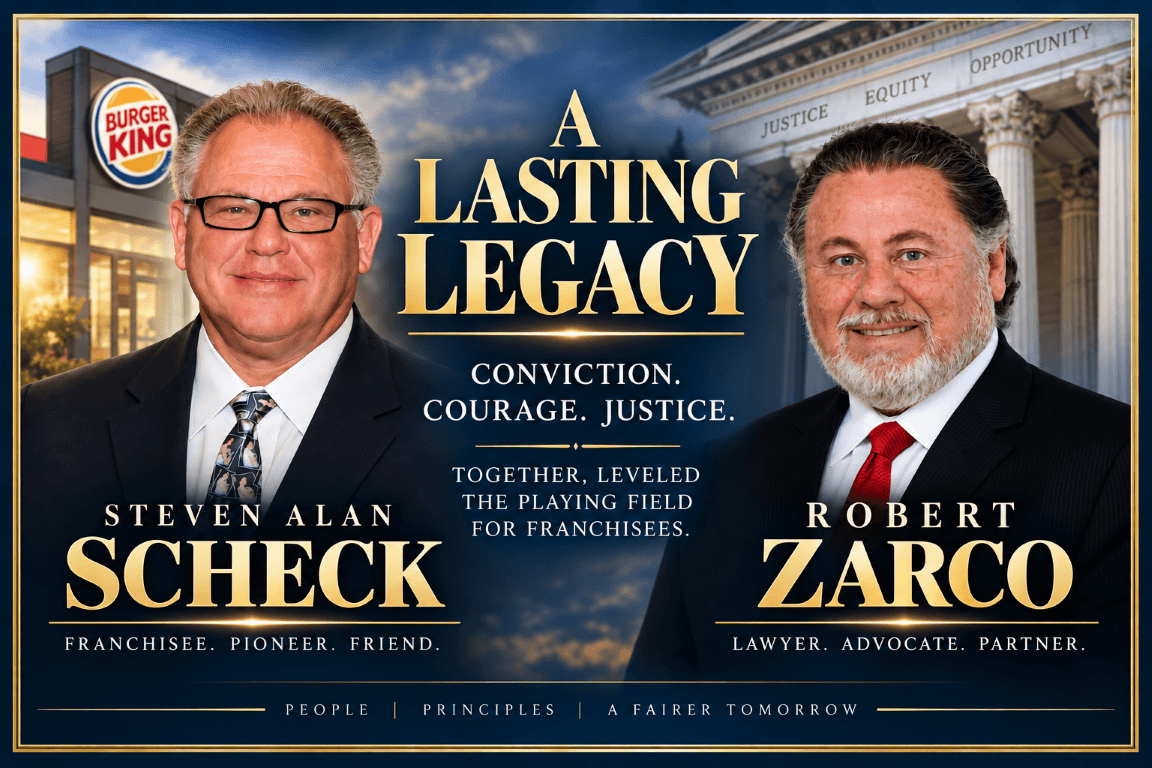
Remembering Steven Alan Scheck, the Burger King franchisee whose courage and conviction helped advance franchisee rights, shape the career of Robert Zarco, and leave an enduring mark on the franchise world.
Reviewed and Approved by Robert Zarco
Some legal cases begin as ordinary business disputes. A few come to stand for something much larger.
For Steven Alan Scheck, the issue was about justice and principle: a franchisee who had invested his livelihood in a business should have the right to expect that his franchisor would deal with him fairly.
For Robert Zarco, then a young Miami commercial trial lawyer, Scheck’s fight would become far more than an early case. It would become a defining battle, one that would test his convictions, help launch his own law practice, and set the course for a career taking on powerful adversaries “Against All Odds.”
More than three decades later, Scheck v. Burger King Corp. remains an important chapter in franchise law and in Zarco’s lifelong commitment to leveling the playing field for franchisees and business owners facing substantially more powerful commercial adversaries.
With Scheck’s passing at age 77, Zarco Einhorn Salkowski, P.A. remembers not only the franchisee behind a landmark legal battle, but also the entrepreneur, pioneer, friend, and man whose willingness to stand up for what he believed was right helped change the conversation about the relationship between franchisors and franchisees.
A Franchisee Who Refused to Back Down
Scheck was no stranger to the hospitality business.
A graduate of the Cornell University School of Hotel Administration, he built a decades long career in hospitality and held leadership positions at prominent properties including the Hershey Motor Lodge and Convention Center, the Concord Hotel, and New York’s legendary 21 Club.
He later became an entrepreneur, ultimately owning and operating four Burger King franchises and two full-service restaurants in Massachusetts, and serving on the National Franchise Association’s Board of Directors.
One of Scheck’s Burger King restaurants was located in Lee, Massachusetts, and benefited substantially from travelers using the Massachusetts Turnpike.
Then another Burger King opened approximately two miles away at a Turnpike location positioned to intercept many of those customers.
The consequences were devastating.
According to Zarco at the time, Scheck lost approximately $300,000 annually in sales, representing 30 to 35 percent of his existing restaurant’s gross sales. The financial impact of the franchise encroachment and resulting cannibalization ultimately forced Scheck into bankruptcy.
There was another problem: Scheck’s franchise agreement did not grant him an exclusive territory.
To others, that appeared to end the matter.
To Scheck and Zarco, it did not.
Robert Zarco explains franchise encroachment and cannibalization and the importance of protecting a franchisee’s market territory.
A Case Others Considered “Worthless”
Several larger, established law firms had assessed Scheck’s case as “worthless,” according to Zarco.
Scheck believed he had been treated unfairly. The young Miami commercial trial lawyer representing him saw something others did not: a principle worth fighting for and a case worth pursuing.
Robert Zarco saw it differently. He was willing to take the case, take on Burger King, and give Scheck his day in court.
The absence of an exclusive territory, Zarco argued, should not necessarily give a franchisor unlimited discretion to exercise its contractual rights in a way that could deprive a franchisee of the benefits of the very agreement into which the parties had entered.
At the center of the argument was the implied covenant of good faith and fair dealing.
When Zarco left his prior firm to establish his own law practice in April 1992, he took Scheck and the case with him.
Scheck took a chance on the young attorney.
Zarco saw value and a challenge where others did not. More importantly, he saw a principle worth fighting for with the opportunity to do the right thing.
The “Key to the Courthouse”
There was still the practical reality of taking on one of the world’s largest restaurant companies.
Scheck’s business had already suffered severe financial damage. Complex commercial litigation against a major international franchisor required resources he no longer had.
Zarco agreed to pursue the matter on a contingency and results-accomplished attorney fee basis, providing what he would later describe as the “key to the courthouse.”
For Zarco, the concept was fundamental: the size and economic power of an opponent should not determine whether an entrepreneur has a meaningful opportunity to protect his or her rights and livelihood.
That principle would ultimately become part of the philosophy behind the national franchise law practice at Zarco Einhorn Salkowski, P.A..
A Decision That Helped Change the Legal Landscape for Franchisees
In Scheck v. Burger King Corp., 756 F. Supp. 543 (S.D. Fla. 1991), U.S. District Judge William M. Hoeveler denied Burger King’s request for summary judgment on Scheck’s claim for breach of the implied covenant of good faith and fair dealing.
The Court found that although Scheck did not possess an exclusive territory, that did not necessarily mean Burger King had an unfettered right to open nearby franchises without regard to their effect on his existing operation.
At the heart of Judge Hoeveler’s reasoning was the principle that while Scheck was not entitled to an exclusive territory, he was entitled to expect that Burger King would not exercise its contractual rights in a manner that destroyed his ability to enjoy the benefits of the franchise agreement.
Burger King sought reconsideration. In Scheck v. Burger King Corp., 798 F. Supp. 692 (S.D. Fla. 1992), the Court declined to retreat from its earlier analysis.
The significance extended beyond one Burger King restaurant in Massachusetts.
The case challenged prevailing assumptions about the balance of power in the relationship between franchisors and franchisees and helped advance the conversation about a franchisor’s obligations in exercising contractual discretion, particularly under the implied covenant of good faith and fair dealing.
Importantly, Scheck did not create the implied covenant of good faith and fair dealing. The doctrine was already recognized under Florida law. But the case became an influential authority in the franchise context and raised important questions about how those principles could apply when a franchisor’s exercise of contractual discretion threatened the economic interests of an existing franchisee.
Like many significant decisions addressing the boundaries of contractual discretion, aspects of Scheck have subsequently been distinguished, limited or questioned by other courts. Its historical importance does not rest on creating unlimited protection against competition or establishing an exclusive territory where none existed. Rather, the case helped advance the legal discussion about whether a franchisor’s contractual discretion may nevertheless be constrained by the obligations of good faith and fair dealing.
Robert Zarco discusses the importance of good faith and fair dealing in the franchisor-franchisee relationship.
A “Landmark in the Making”
The franchise community noticed.
On December 1, 1992, the Miami Review, then the Daily Newspaper of Business, Real Estate and Law, featured the litigation under the headline “Burger King Faces Franchise Fight,” with the sub-headline “Dispute over newer outlet could change industry practices.”
The newspaper described the case as a “landmark in the making.”
The article also quoted independent Miami franchise attorney Ronald Fieldstone, who was not involved in the case, describing it as a landmark and discussing its potential significance in clarifying a franchisor’s duty to exercise good faith when opening company stores or additional franchises.
What began as the fight of one financially devastated franchisee had become part of a much larger discussion about encroachment, cannibalization, contractual discretion, and the obligations inherent in the franchisor-franchisee relationship.
The case was ultimately resolved for an amount that has been publicly disclosed as exceeding several million dollars.
A case that several established law firms had dismissed as “worthless” had become an influential franchise dispute, challenging assumptions about the limits of franchisor power and the rights of franchisees.
For Robert Zarco, the case had become something even more personal: a defining experience that revealed the kind of lawyer he wanted to be, the clients he wanted to fight for, and the powerful interests he was willing to challenge.
The Case Draws Academic Attention
The significance of Scheck v. Burger King Corp. soon extended beyond the courtroom and news media into legal scholarship.
In 1994, the University of Miami Law Review published a scholarly analysis devoted to the case: “Scheck v. Burger King Corp.: Why Burger King Cannot Have Its Own Way with Its Franchisees,” by Adam B. Leichtling, 48 U. Mia. L. Rev. 671 (1994).
Published only a few years after the federal court decisions, the article examined Scheck in the broader context of the franchise relationship, territorial rights, contractual discretion, and the implied covenant of good faith and fair dealing.
Its publication provides another important historical marker in the evolution of the case: what the Miami Review had described in 1992 as a “landmark in the making” had become the subject of dedicated academic legal analysis by the University of Miami Law Review in 1994.
The Principles of Scheck Live On
The issues raised by Scheck did not end with that litigation.
More than two decades later, Zarco would again litigate questions involving encroachment, non-exclusive territory, and the implied covenant of good faith and fair dealing, this time on behalf of longtime El Pollo Loco franchisees in California.
In 2018, Zarco Einhorn Salkowski reported that a Los Angeles County jury found that El Pollo Loco, Inc. breached the implied covenant of good faith and fair dealing in connection with two new corporate restaurants opened near an existing franchisee’s location. The firm noted the relationship between the legal principles involved in that dispute and those addressed years earlier in Scheck v. Burger King Corp.
For Zarco, the connection underscored how issues first confronted with Scheck decades earlier continued to arise in disputes over franchise territories, contractual discretion, and the economic interests of existing franchisees.
More Than Three Decades Later, the Case Draws Attention Again
The story did not disappear with the end of the litigation.
More than three decades after the Miami Review described Scheck v. Burger King Corp. as a “landmark in the making,” the passing of Steven Scheck brought the case and the questions it raised back into the national conversation.
On September 10, 2026, Nation’s Restaurant News published “Steven Scheck, franchisee behind pioneering legal case, dies,” by veteran restaurant industry journalist Jonathan Maze, Editor in Chief of Restaurant Business.
Maze reported that Scheck’s 1989 lawsuit against Burger King helped solidify a franchise legal principle that continues today and examined how the case gave franchisees a meaningful legal tool when challenging the exercise of franchisor discretion.
Days later, QSR Magazine published “Remembering the Legacy of Steven Scheck,” revisiting the Burger King dispute and the broader issues at its center, including franchise encroachment, cannibalization and the implied covenant of good faith and fair dealing.
The QSR story also explored the human story behind the litigation: a franchisee facing devastating business losses and a young attorney willing to pursue a case that several larger, established law firms had assessed as “worthless,” according to Zarco.
Read QSR Magazine’s “Remembering the Legacy of Steven Scheck.”
The Nation’s Restaurant News story also received broader business and financial distribution through Yahoo Finance, extending the Scheck story beyond the restaurant and franchise industries.
Read the Steven Scheck story on Yahoo Finance.
The case also has a dedicated Wikipedia entry documenting Scheck v. Burger King Corp., including its factual background, procedural history, federal court decision and legal issues involving franchisee territorial rights and the implied covenant of good faith and fair dealing.
Read the Wikipedia entry on Scheck v. Burger King Corp.
The progression tells its own story.
1992: The Miami Review describes a “landmark in the making.”
1994: The University of Miami Law Review devotes scholarly analysis to the case.
2026: Nation’s Restaurant News revisits Scheck’s “pioneering legal case.”
2026: QSR Magazine examines “the legacy of Steven Scheck.”
A dispute that began with one Burger King franchisee in Massachusetts had become part of the broader history of franchise law, still being examined and discussed more than three decades later.
From One Franchisee’s Fight to a Lifelong Mission
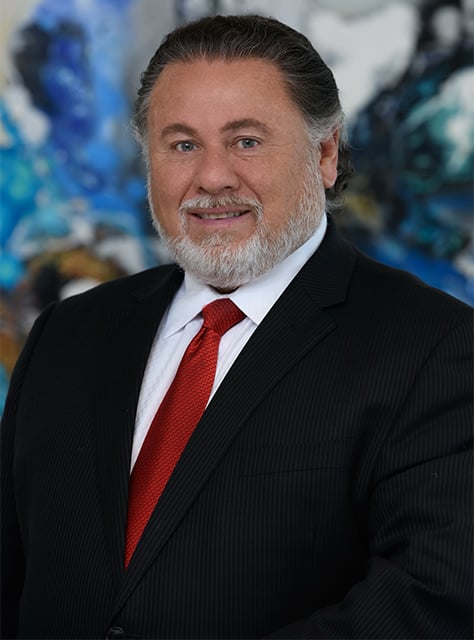
For Zarco, Scheck became far more than an early case.
It demonstrated that one franchisee, given the opportunity to be heard, could challenge an industry giant and influence the rights of those who followed.
Today, Robert Zarco is Founder and Managing Partner of Zarco Einhorn Salkowski, P.A., appropriately known as The Great Equalizers.
Over the decades that followed, Zarco and the firm have represented thousands of franchisees associated with more than 500 franchise systems across 44+ states and 20+ countries, including 40+ franchisee associations, continuing a mission centered on creating leverage and leveling the playing field.
The firm also continues to utilize creative hybrid contingency and results-accomplished fee arrangements in appropriate cases, helping qualifying franchisees and business entrepreneurs pursue their rights when the cost of complex commercial litigation might otherwise place meaningful legal representation beyond their reach.
The philosophy and lessons that emerged from Scheck’s fight remains remarkably simple and relevant over three decades later.
Access to justice should not depend upon the size of the opponent.
More Than a Client
The legal case eventually ended.
The relationship did not.
What began as an attorney-client relationship became a friendship between Scheck and Zarco that endured for more than three decades.
“My dad was never afraid to stand up for what he believed was right,” said Hayley Scheck Antonian, Steven’s daughter. “He was an entrepreneur at heart, and he believed deeply in his businesses and the people he trusted. He took a chance on Robert more than three decades ago because he believed in him and in the case he was fighting. What began as a business relationship ultimately became a lifelong friendship. I’m incredibly proud that my dad’s courage and conviction became part of a legacy that continues to impact franchisees today.”
For Zarco, memories of Scheck extend far beyond courtrooms, legal briefs, and franchise law.
“Scheck was a wonderful human being,” Zarco said. “His larger-than-life physical presence was balanced by his warm heart and teddy bear personality, yet he remained firm in his convictions.”
Zarco also remembers the courage it took for Scheck to challenge a powerful franchisor at a time when doing so carried substantial personal and financial risk.
“The franchisee community respected him greatly for standing up for what he believed in and not living in fear of retaliation,” Zarco said.
Their friendship continued through the decades.
“We developed a personal relationship that lasted more than three decades,” Zarco said. “We spoke frequently and supported each other through personal life issues as they arose. I will miss him.”
The Man Behind the Case Name
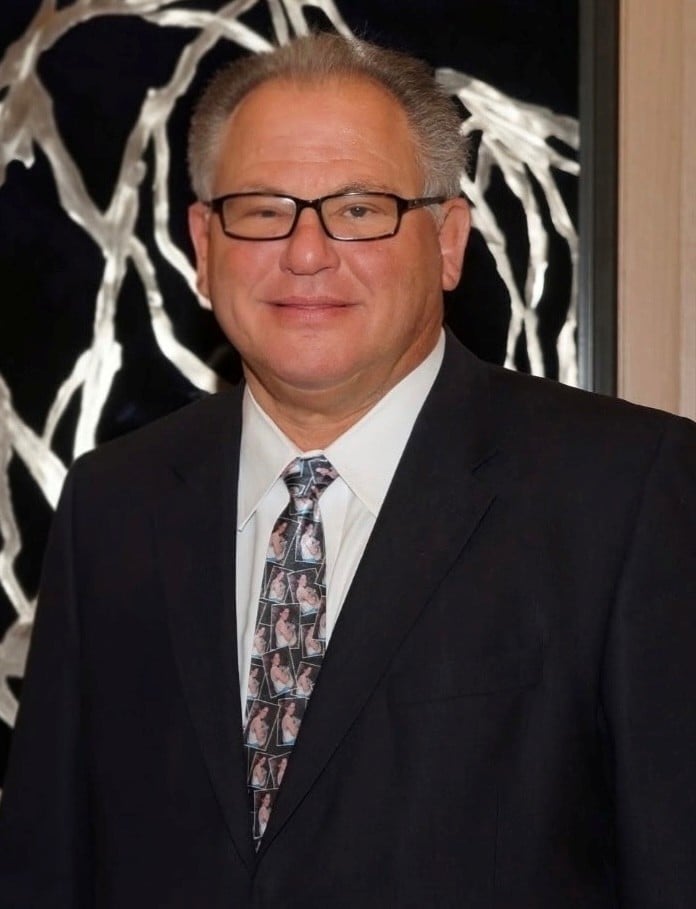
Steven Scheck’s life did not end with the litigation that bears his name.
In 1993, he moved to Los Angeles, where he became General Manager of the Sportsmen’s Lodge Hotel in Studio City, a position he held for many years.
His professional life reflected what those who knew him understood personally: Steve Scheck was an entrepreneur and hospitality professional who believed deeply in his businesses, his relationships, and his principles.
Steven Scheck never set out to become the name behind a consequential franchise case. He was a businessman who believed he had been wronged and had the conviction to stand up for what he believed was right, even when the odds were against him.
There could have been no Scheck v. Burger King Corp. without Steven Scheck. It was his livelihood at stake, his willingness to fight, and his faith in a young lawyer that set everything that followed in motion…with a mission that continues to this day.
And the legacy of Robert Zarco and the law firm he founded will always carry a piece of Steve Scheck’s legacy with it.
Steve Scheck believed in Robert Zarco. Robert Zarco believed in Steve’s cause. Together, they left an enduring mark on the franchise landscape, helping level the playing field between franchisors and franchisees and showing what can happen when conviction meets courage.
The rest is history.